Whales are among the largest and most remarkable animals on Earth. These marine mammals live in oceans around the world, from warm tropical waters to the cold seas surrounding the poles.
Life Beneath the Surface
Although whales spend their lives in water, they breathe air through blowholes located on top of their heads. They must regularly return to the surface to breathe before diving again in search of food or traveling through the ocean.
Whales are warm-blooded, give birth to live young, and nurse their calves with milk. A thick layer of fat called blubber helps protect them from cold water and stores energy during long migrations.
Two Main Groups
Whales are generally divided into baleen whales and toothed whales. Baleen whales filter small animals from the water using flexible plates inside their mouths. This group includes blue whales, humpback whales, and gray whales.
Toothed whales use teeth to catch fish, squid, and other prey. Many of them also use echolocation, producing sounds and listening for returning echoes to understand their surroundings. Sperm whales, belugas, and orcas belong to this group.
The Blue Whale
The blue whale is the largest known animal to have ever lived. An adult can grow longer than a city bus and weigh well over one hundred tonnes. Despite its enormous size, it feeds mainly on tiny crustaceans called krill.
Communication and Migration
Whales communicate using clicks, whistles, pulses, and complex songs. Some sounds can travel across great distances underwater. Humpback whales are especially famous for their long, patterned songs.
Many species migrate thousands of kilometres each year. They often feed in cold, nutrient-rich waters before traveling to warmer regions where they mate and give birth.
Protecting Whales
Commercial hunting once caused severe declines in many whale populations. Today, whales also face threats from fishing gear, ship collisions, underwater noise, pollution, and changes to ocean ecosystems.
Conservation programs, safer fishing practices, protected habitats, and international cooperation can help whale populations recover. Protecting whales also supports healthier oceans because these animals play an important role in marine food webs and nutrient cycles.
Hereford · By Jonathan Jefferson · September 2026 · 8 min read
Black Hereford Cattle: What They Are and How They’re Bred
A black hereford isn’t a separate breed the way Angus or Hereford are — it’s a black-hided, white-faced animal that comes from crossing Hereford genetics with black cattle, usually Angus, and then working to stabilize that look and frame over generations. If you’ve seen a black baldy calf and wondered why it looks like a Hereford wearing a black coat, that’s essentially the same genetic combination, just taken further by breeders who kept selecting for it on purpose.
We’ve raised plenty of black baldy calves at Rochelle over the years from crossing Hereford cows with Angus bulls, so we get asked about black Herefords regularly. This post covers where the color actually comes from, how it differs from a one-generation black baldy cross, and what to expect if you’re buying one. If you want to see the type in person, our current black hereford cattle for sale listing shows what we have on hand.
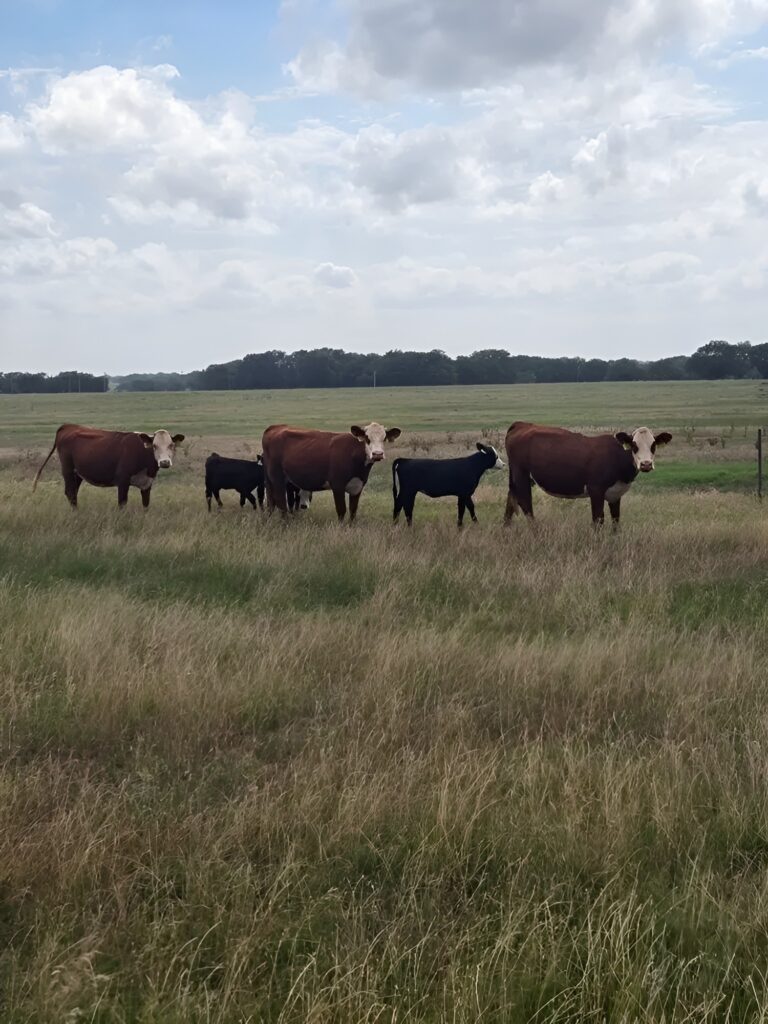
This black, white-faced look is the hallmark of black Hereford genetics.
Where the Black Hereford Color Comes From
Black hereford cattle get their color from the dominant black gene carried by Angus or other black-hided cattle, crossed onto Hereford genetics that carry the white face pattern. A single-generation cross — a black baldy — combines both traits in one calf, but it isn’t a stable, repeatable type on its own. Breeders working toward a true black hereford cow selectively breed for the black hide and white face together across multiple generations, aiming for consistency rather than a one-off cross. This is different from simply running a hereford angus cross for one calf crop — a black Hereford program is aiming for a repeatable, predictable animal generation after generation, not a single cross.
Black Hereford vs. a One-Generation Black Baldy
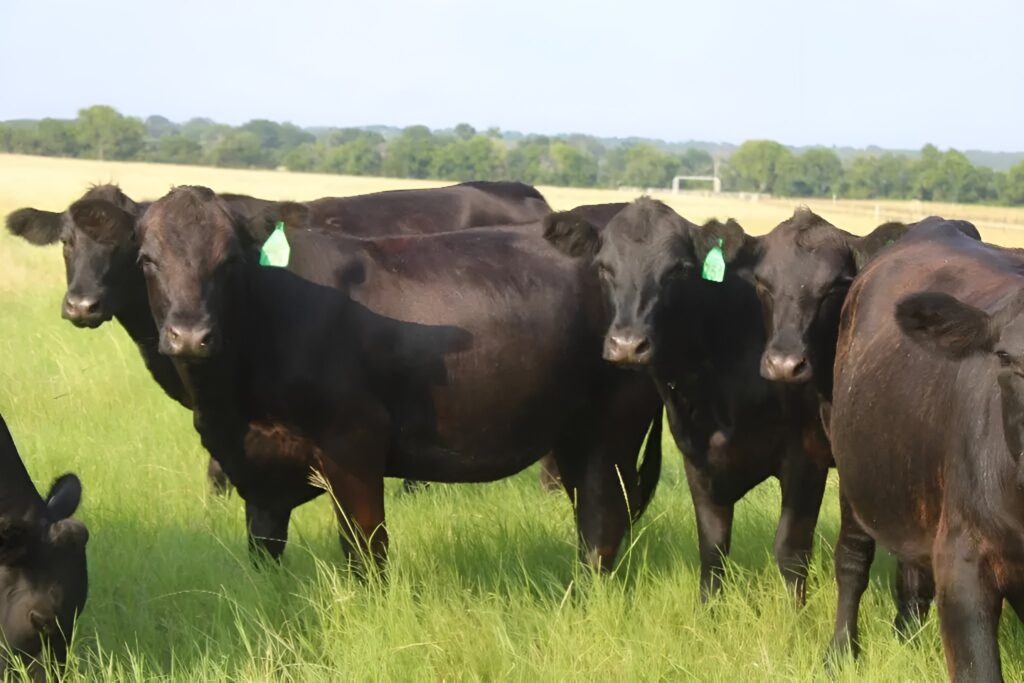
One of the more useful hereford cattle facts here is that a black baldy calf and a black Hereford aren’t automatically the same thing, even though they can look nearly identical. Our 37 Angus Super Baldy Bred Heifers are a good example of the type — black-bodied with the white face — produced through a Hereford-influenced Angus cross program rather than a single random pairing, which is closer to what buyers usually mean when they ask about black Herefords.
A one-generation black baldy calf — the starting point for a stabilized black Hereford program.
How Consistent Are Black Hereford Cattle Characteristics?
This is where a lot of buyers get surprised. Hereford cattle characteristics like frame, disposition and easy fleshing carry through fairly reliably from the Hereford side of a black Hereford program, but color and facial markings take longer to lock in. Early generations can show more variation — a white patch in the wrong place, a body color that leans brown rather than black — because the black gene and the white-face pattern are inherited somewhat independently. A breeder who has been selecting for the type over several generations will have a tighter, more predictable set of characteristics than one who’s only a generation or two into the cross, which is worth asking about directly rather than assuming from a single photo.
Horned, Polled and Frame — What Stays the Same
Whether an animal is polled or horned has nothing to do with color; polled hereford cow lines and horned hereford cattle both contribute to black Hereford programs depending on which bulls and cows are used, and both are registered through the same American Hereford Association standards on the Hereford side of the pedigree. Frame and other hereford breed characteristics — moderate size, easy fleshing, calm temperament — tend to carry through from the Hereford side of the cross, since those are the traits most black Hereford programs are trying to keep. The black hide itself traces back to American Angus Association-registered genetics somewhere in the pedigree, even a few generations back.
What to Look For When Buying
If you’re specifically shopping for the black, white-faced look, ask how many generations of selection are behind the animal, not just whether the calf’s dam or sire happened to be black. Our 3 Reg. Hereford 2nd-Calf Pairs come from polled Hereford cows already raising black baldy calves by a registered Angus bull, which is a fair hereford cattle description of the cross most buyers are actually picturing when they ask about black Herefords. If you’d rather start with a herd sire, our hereford bulls for sale page lists current Hereford bulls.
Consistency across generations, not a single cross, is what separates a program like this from a one-off black baldy calf.
Buyer note: Ask about generations behind the color, not just the calf’s parents — a stable black Hereford type takes more than one cross to establish.
From our place
We didn’t set out to build a black Hereford program specifically — it happened because we’ve run Angus bulls on our Hereford cows for years to get black baldy calves that sell well at the sale barn. What we’ve learned is that consistency takes longer than most people expect; the first cross gives you the look, but holding that look, along with the frame and disposition we actually want, takes several generations of paying attention to which animals we keep back. If you’d rather start with a proven pair already raising a black baldy calf, browse our hereford calves for sale listings.
Not in the same sense as Angus or Hereford. Black Hereford describes a black-hided, white-faced type built by crossing Hereford genetics with black cattle, usually Angus, and then breeding for consistency. Some organizations maintain registries for the type, but it’s a composite rather than a long-established purebred.
What’s the difference between a Black Hereford and a black baldy?
A black baldy is typically the direct result of a single cross between a black-hided animal and a Hereford. A black Hereford program takes that same combination and selects for it across multiple generations to make the look and frame repeatable rather than a one-time result.
Are Black Hereford cattle polled or horned?
Either is possible. Polled and horned are separate genetic traits from color, so a black Hereford can carry either the polled or horned gene depending on which Hereford genetics are behind it.
Do Black Herefords have the Hereford white face?
Yes, the white face is one of the defining traits breeders select for, alongside the black hide. That combination — black body, white face — is what most buyers picture when they hear the term.
Why do breeders cross Hereford with Angus for color?
Black-hided calves with a white face often sell at a premium at the sale barn because buyers associate the look with Angus-influenced genetics and good hybrid vigor. Crossing also combines Hereford’s moderate frame and disposition with Angus carcass traits.
Are Black Hereford cattle registered?
It depends on the program. Some breeders register black Hereford-type cattle through composite or crossbred registries, while others simply market them as commercial black baldy or black Hereford-type cattle without formal papers.
A black Hereford comes down to genetics and generations, not a separate breed standard — the black hide from one side, the white face and frame from the other, held together by consistent selection over time.
Looking for Black Hereford Type Cattle?
Every animal we list is priced on the listing — check current hereford cow price figures and know that delivery is arranged to all 48 states.
Angus · By Jonathan Jefferson · September 2026 · 7 min read
Fun Facts About Angus Cows Every Buyer Should Know
If you ask around, most people can only name one fun fact about angus cows: that they’re black. There’s more to it than that — where the breed actually came from, why they don’t have horns, and why one healthy Angus cow occasionally throws twins are the kind of details that make more sense once you’ve worked cattle for a while. Here are the ones we actually find ourselves explaining to buyers.
We’ve run Angus cattle at Rochelle for more than 25 years, and these are the facts that come up most on the phone — not textbook trivia, but the ones that actually help you understand what you’re buying. If you want to see the breed in person before reading further, our angus cattle for sale listing is a good place to start.
Solid black, naturally polled, and built for a wide range of climates.
The Angus Breed Started in Scotland, Not Texas
One of the more surprising facts is that Angus cattle originated in Aberdeenshire and Angus counties in Scotland, developed from native black, hornless cattle long before the breed ever set foot in the US. The American Angus Association was formed in 1883 to register the breed here, and from there Angus spread across the country because the cattle handled a wide range of climates — a useful trait when you go from Scotland’s damp hills to a Texas summer. Early importers brought the breed over specifically because it held up on rougher forage than some of the larger continental breeds available at the time, which is part of why it caught on so quickly with commercial ranchers.
Angus Cattle Are Naturally Polled — No Horns, No Dehorning
Angus cattle are naturally polled, meaning they’re born without horns as part of their genetics, not because of any human intervention. That’s actually one of the reasons Angus bulls are used so often on horned breeds like Hereford — crossing a polled Angus bull onto horned cows reliably removes horns from the calf crop, which is part of where black baldy cattle come from.
Angus Genetics Occasionally Throw Twins
Twinning isn’t the norm in cattle, but it happens in Angus more often than most people expect, and it’s not something you can plan for — it’s just genetics showing up. We’ve had it happen on our own place; our Angus Cow W/Twins listing right now is a nine-year-old cow that raised a bull and heifer calf together this past August. It’s a fun fact, but also a practical one: a cow that’s thrown twins once is a little more likely to do it again.
A nine-year-old Angus cow with her twin bull and heifer calves, born this past August.
Angus Cattle Adapt to Nearly Any Climate
Another one of the practical angus cattle characteristics that gets overlooked is how well the breed adapts across climates. The same genetics that worked in Scotland’s damp, cool hills have held up in the Texas heat, the Midwest cold, and everywhere in between, which is part of why Angus became the most common beef breed in the country rather than staying a regional specialty. That kind of adaptability doesn’t show up as a single trait on paper, but it’s one of the reasons commercial operations across such different climates all lean on the same breed, from fescue country to caliche pasture.
Black Angus Cattle Built an Entire Beef Brand
Black angus cattle are the foundation of an entire branded beef program — Certified Angus Beef exists specifically because the breed’s angus cattle description, in terms of marbling and carcass consistency, made it worth building a separate quality standard around. That’s part of why calves with any black angus cow influence often sell at a premium at the sale barn, papers or not.
Angus Cattle Are Known for Calm Temperament
Among the angus cow characteristics that don’t show up on paper, temperament is one buyers notice fastest. Angus cattle have a reputation for being easier to handle than a lot of horned continental breeds, which is one of several angus characteristics that made the breed popular with small-acreage owners and 4-H families, not just commercial operations. If you’re looking to start a first heifer project, our angus heifers for sale listings are a common starting point.
A well-handled young heifer, the kind that builds a herd’s reputation for being easy to work.
Buyer note: Temperament is partly genetic and partly taught — ask how an animal has been handled before assuming breed alone explains her disposition.
From our place
After 25 years of running Angus, the fun fact about angus cows we come back to most isn’t in any book — it’s that a good cow will teach her calf almost everything it needs to know about being handled, good or bad. We’ve watched black angus calves raised by a flighty cow turn out flighty themselves, and calm cows raise calm calves, generation after generation. That’s one of the angus cow facts we weigh as heavily as any pedigree when we decide which cows stay in our own herd.
What’s a fun fact about Angus cows that most people don’t know?
Many people don’t realize Angus cattle originated in Scotland, not the US, and were naturally polled from the start rather than bred to lose their horns later. The breed’s spread across American ranches happened well after it was already established overseas.
Are all Angus cattle naturally polled?
Yes, polled is a defining trait of the Angus breed — it’s not a separate variety like it is in Hereford cattle. An Angus born with horns or scurs is unusual and typically points to some outside breeding somewhere in its background.
Do Angus cows really have twins?
Occasionally, yes. Twinning happens across most cattle breeds at a low rate, but it does occur in Angus, and a cow that has thrown twins once is somewhat more likely to do it again. It’s not something a buyer can predict or select for reliably.
Where did Angus cattle originally come from?
Angus cattle originated in Aberdeenshire and Angus counties in Scotland, developed from native black, hornless cattle. The American Angus Association was formed in 1883 to register the breed in the US, and it has grown into one of the country’s most common beef breeds since.
Why is Angus beef considered better?
Angus cattle tend to marble well relative to their frame size, which is why Certified Angus Beef exists as its own branded quality program. Genetics alone don’t guarantee a top grade, but Angus genetics make it a more consistent target than many other breeds.
Are Angus cattle easy to handle?
Generally, yes — Angus have a reputation for calm temperament compared to many horned or continental breeds. Individual disposition still depends heavily on how the animal has been handled from birth, not just its breed.
Most of what makes Angus cattle worth knowing comes down to a handful of facts like these — Scottish origin, natural polling, calm temperament and a beef brand built around their carcass quality — rather than anything complicated.
Ready to See These Facts in the Field?
Every animal we list is priced on the listing, with health papers included, and delivery arranged to all 48 states — check current angus cattle prices before you call.
Angus · By Jonathan Jefferson · September 2026 · 8 min read
Angus Cow Weight: Registered vs Commercial Frame Size
If you’re trying to figure out what an Angus cow should weigh before you buy, the honest answer is: it depends on whether she’s registered seedstock or a commercial cow, and how old she is. Angus cow weight for a mature commercial cow typically runs 1,100 to 1,400 pounds, while registered seedstock cows often run heavier depending on the line and how she’s fed. Frame size, not just breed, is what actually drives the number.
We’ve weighed and sorted Angus cattle at Rochelle for more than 25 years, both registered and commercial, and the weight question comes up on almost every call. This post walks through what to expect at each stage — birth, weaning, yearling, breeding age and mature — and why registered and commercial cows don’t always land in the same range even though they’re both Angus. If you’re shopping cow-calf pairs right now, our angus cows for sale listings note weights on every pair.
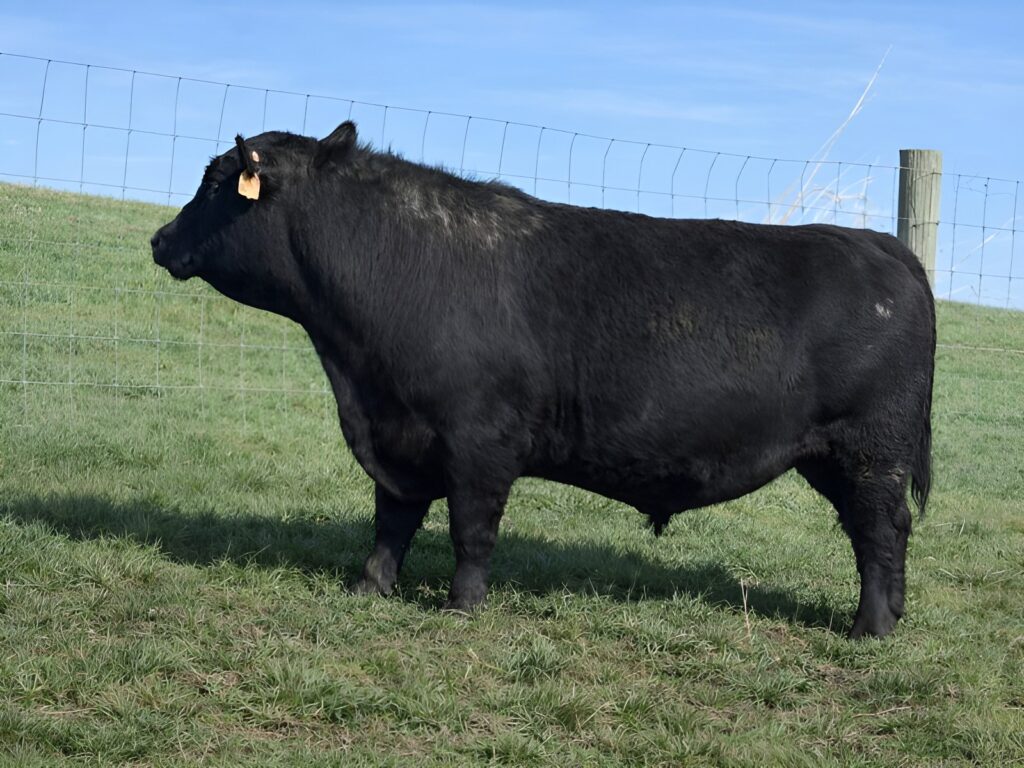
Mature herd bulls like this one commonly run 1,800 to 2,200 pounds — well above cow weight.
Angus Cow Weight by Age and Class
Beef cattle angus size follows a fairly predictable curve from birth to maturity, and knowing where an animal should be at each stage helps you spot one that’s behind or ahead of where she should be. These are typical ranges, not guarantees — individual condition, nutrition and bloodline all shift the numbers.
Class
Typical weight
Notes
Birth
65–85 lb
Low-birth-weight bulls run lower
Weaned calf (6–7 mo)
450–600 lb
Depends on milk and grass
Yearling heifer (12 mo)
650–800 lb
Growing toward breeding weight
Bred heifer (18–20 mo)
850–950 lb
Roughly 65% of mature weight when bred
Mature commercial cow
1,100–1,400 lb
Moderate frame
Mature registered cow
1,300–1,600 lb
Varies by bloodline
Mature bull
1,800–2,200 lb
Working condition
A heifer like this is still building toward the 850–950 lb range typical at first breeding.
Frame Score: The Number Behind the Weight
One of the angus cattle characteristics that ties directly to weight is frame score, a 1-to-9 scale cattlemen use to describe skeletal size independent of body condition. A moderate-framed animal, roughly a 4 to 6 on the scale, fills out to the weight ranges above; a heavier-framed animal will simply carry more pounds at every stage, from weaning through maturity, even on the same nutrition program. Frame score is also why two Angus cows can look similar standing side by side but land 200 pounds apart on the scale — the taller, longer-bodied cow is carrying a bigger frame, not necessarily more fat. It’s worth asking about frame score alongside weight when you’re comparing two animals, since weight alone doesn’t tell you whether you’re looking at a moderate cow in good flesh or a large-framed cow that’s actually thin.
Registered vs. Commercial — Why the Numbers Differ
Part of the gap between registered and commercial angus cow characteristics comes down to selection goals. Registered breeders often select for somewhat larger mature size because it correlates with growth EPDs that bull buyers want, tracked through American Angus Association records, while commercial operations frequently favor moderate-framed black angus cow genetics that breed back reliably on grass without extra supplementation. Both are still black angus cattle by any accurate angus cattle description — the difference is which traits the breeder has been selecting for over generations, not a difference in the breed itself.
Angus Heifers for Sale — What Weight to Expect
If you’re shopping bred heifers, ours are typically 18 to 20 months and running 850 to 950 pounds at the time they’re bred — our 13 Angus Bred Heifers listing gives exact weights for that group. Our angus heifers for sale category shows current inventory once that group sells.
Bred heifers at 18 to 20 months, running roughly 850 to 950 pounds.
What Bull Weight Tells You (and Doesn’t)
A bull’s own weight is a poorer predictor of his calves’ size than his EPDs are. Our 5 Reg. Angus Bulls run around 2,000 pounds at maturity, but what actually matters for your herd is his birth-weight and growth EPDs, not the number on his own scale ticket. If you’re shopping herd sires, our angus bull sales page lists current bulls with EPDs attached.
Buyer note: A bull that’s heavier than average isn’t automatically throwing bigger calves — check his EPDs, not just his own scale weight.
From our place
On our own place, we track weight less than we track condition — a cow holding a body condition score of 5 or 6 through winter tells us more than a scale number does, and it’s one of the angus cow facts that doesn’t always make it into a sale ad. That said, we do weigh bred heifers before they go out with a bull, because a heifer bred too light is asking for calving trouble regardless of what breed she is. We’ve also learned to look at a cow’s frame relative to her age before worrying about the number on the scale — a two-year-old still filling out will weigh less than a mature cow of the same frame score, and that’s normal growth, not a fault.
A mature commercial Angus cow typically weighs 1,100 to 1,400 pounds on a moderate frame. Registered seedstock cows can run somewhat heavier, often 1,300 to 1,600 pounds, depending on the bloodline and how she’s been fed.
How much does an Angus bull weigh?
A mature Angus bull in working condition commonly weighs 1,800 to 2,200 pounds. Yearling bulls weigh considerably less and are still filling out, which is why growth EPDs matter more than his weight at that age.
What’s the difference between registered and commercial Angus cow weight?
Registered cows often run somewhat heavier at maturity because breeders have selected for larger frame alongside growth traits. Commercial cows tend to run more moderate, since many commercial operations prioritize a frame that breeds back reliably on grass over maximum size.
How much should a bred Angus heifer weigh?
A bred heifer should generally be around 65% of her expected mature weight at breeding, which typically works out to 850 to 950 pounds for an 18 to 20 month heifer bred to calve as a two-year-old.
Does frame size affect Angus cow weight?
Yes, significantly. Frame score is one of the biggest drivers of mature weight within the breed — a larger-framed cow will simply weigh more than a moderate-framed cow at the same body condition, regardless of bloodline.
What’s a healthy weaning weight for an Angus calf?
Most Angus calves wean at 6 to 7 months weighing 450 to 600 pounds, depending on the cow’s milk production, available grass and whether the calf was creep fed. Bull calves typically wean slightly heavier than heifers.
Angus cow weight comes down to frame, age and whether you’re looking at registered or commercial genetics — the table above covers most of what a buyer actually needs before making an offer, and frame score fills in the rest of the picture when two animals land at different points on the scale.
Looking for Angus Cattle at the Right Weight and Frame?
Every animal we list notes weight and age on the page, and everything is priced on the listing — see current angus cattle prices and delivery is arranged to all 48 states.
Hereford · By Jonathan Jefferson · September 2026 · 8 min read
Hereford Cattle Calving: A Buyer’s Guide for 2026
If you’re buying into Hereford cattle for the first time, hereford cattle calving is usually the first practical worry — not color, not papers, but whether the cow you buy will calve on her own and raise that calf without you standing in the mud at 2 a.m. The short answer: Herefords have a long track record of easy, unassisted calving, but the details depend on frame, birth weight and whether you’re buying bred females or picking a bull to breed your own.
We’ve calved out Hereford cows and heifers at Rochelle for more than 25 years, both horned and polled, registered and commercial. This guide covers what actually affects calving ease — birth weight, frame, horned versus polled, and how to read a bull’s numbers before you buy him — along with what we do differently at calving time versus the rest of the year. If you’re shopping bred females right now, our hereford heifers for sale listings show heifers already checked for calving readiness.
A herd bull’s birth-weight number matters more to calving ease than his own size.
Hereford Cattle Calving Facts on Birth Weight
One of the more useful hereford cattle facts for a buyer is that birth weight, not frame, is the number that actually predicts calving ease. A big-framed bull can still throw light calves if his birth-weight EPD is low, and a moderate-framed bull can throw heavy calves if his numbers run high. Registered bulls carry EPDs through American Hereford Association records that track this back through the pedigree. Bulls we sell list an actual birth weight alongside their predicted numbers — our 5 Reg. Hereford Bulls ran about 80 lb at birth themselves, which is the kind of number worth checking before you turn a bull out on first-calf heifers.
Horned vs. Polled — Does It Change Calving?
Horned hereford cattle and polled hereford cow lines calve about the same; the horn gene itself has no bearing on calving ease. What changes is that a horned calf needs careful handling at branding and weaning, and some buyers choose polled genetics specifically to avoid that step later, not because it changes anything at birth. If you’re deciding between the two for a first herd, it usually comes down to what you want to manage at working time, not what you’re worried about at calving.
Polled and horned bulls calve about the same; the difference shows up later at working time.
Frame, Hereford Cow Size and What It Means at Calving
Hereford cow size runs moderate compared to some of the larger continental breeds, and that moderate frame is part of why the breed has a reputation for calving without much help. A mature commercial Hereford cow typically weighs 1,100 to 1,400 pounds, similar to a commercial Angus cow, and that frame consistency across the breed’s hereford breed characteristics is one reason commercial operations lean on Herefords for first-calf heifer programs specifically. This kind of consistency across hereford cattle characteristics — frame, calving ease and maternal instinct — is part of why the breed holds up across regions with very different forage bases, from Texas caliche country to fescue pasture further north.
What Assistance Rates Actually Look Like
These numbers reflect general hereford cattle traits rather than a guarantee for any single animal, but they’re a reasonable starting point for budgeting labor and vet calls at calving time. Mature cows bred to a moderate-birth-weight bull rarely need help; the risk climbs mainly when you combine a first-calf heifer with an unproven or high-birth-weight bull.
Scenario
Typical assistance rate
Notes
Mature cow, moderate-BW bull
Under 5%
Typical for a settled commercial herd
First-calf heifer, low-BW bull
5–10%
Still low relative to continental crosses
First-calf heifer, unproven or high-BW bull
15%+
Where most trouble actually shows up
Buying Bred Females vs. Raising Your Own
If hereford cattle calving risk is the main thing you’re buying to reduce, a proven cow that has already calved once without trouble tells you more than any EPD sheet. Our 3 Reg. Hereford 2nd-Calf Pairs come from cows on their second calf, both with black baldy calves at side sired by a registered Angus bull, so you’re seeing calving-ease traits play out rather than betting on paper. If you’d rather start with pairs already through their first calving, browse our hereford calves for sale listings.
A cow already raising her second calf has proven her calving-ease numbers in the field.
Buyer note: Ask for actual birth weights, not just EPDs, on any bull you’re considering for heifers — the real number on his own calves matters as much as the predicted one.
From our place
At Rochelle we calve most of our commercial Hereford cows in late winter to catch spring grass, and we still walk the herd daily through the calving window even though assistance is rare. What we’ve learned over 25 years is that most of the trouble we do see comes from bulls with unproven numbers on first-calf heifers, not from the cows themselves, which is why we’re particular about which bulls we turn out on young females and which ones we’re comfortable putting anywhere. Most of the facts about hereford cows that actually change a buying decision come down to what her first calving looked like, not what her papers say — that’s the question we ask before any of our own commercial cows go back into the breeding pasture. For general reference on calving-season timing and herd nutrition, Texas A&M AgriLife Extension is a resource we point buyers to as well.
Yes, in general. Hereford cows have a long-standing reputation for unassisted calving, largely because of their moderate frame and the breed’s history of selection for maternal ease. Individual results still depend on the specific cow and the bull she’s bred to, so checking actual numbers matters more than relying on breed reputation alone.
What birth weight should I look for in a Hereford bull?
For heifers, look for bulls with birth weights in the 65 to 80 lb range and a low birth-weight EPD relative to the breed average. Mature cows can typically handle a somewhat heavier calf, so the birth weight that matters most depends on what you’re breeding him to.
Does horned or polled affect calving?
No. The polled gene affects whether a calf grows horns, not how easily it’s born. Horned and polled Hereford cattle calve at essentially the same rate; the practical difference between the two shows up later, at branding and weaning.
What size is a Hereford cow at calving?
Hereford cow size for a mature commercial cow typically runs 1,100 to 1,400 pounds. That moderate frame, compared to larger continental breeds, is part of why the breed is associated with easier calving and lower assistance rates.
Should I buy a bred heifer or a proven cow for easier calving?
A proven cow that has already calved without trouble is the lower-risk option, since you’re seeing results rather than predictions. Bred heifers cost less but carry more uncertainty, especially if bred to an unproven bull.
When do most Hereford cows calve?
Timing depends on when they were bred, but many commercial operations in Texas aim for late winter to early spring calving to match calf growth with green grass. Fall calving is also common depending on your forage program and market timing.
Birth weight, frame and horned-versus-polled cover most of what actually changes hereford cattle calving outcomes — everything past that comes down to the individual cow or bull in front of you.
Looking for Hereford Cattle Bred for Easy Calving?
Every animal we list is priced on the listing — see current hereford cow price figures and know that delivery is arranged to all 48 states.
Angus · By Jonathan Jefferson · September 2026 · 8 min read
What Angus Cattle Facts Actually Matter to a Buyer?
When you’re standing at a fence trying to decide whether to write a check, most of the Angus cattle facts you’ll find online don’t tell you what you actually need to know. The ones that matter come down to five things: color and papers, frame and weight, temperament, calving ease, and how the animal is likely to finish. Everything else is trivia.
We’ve run Angus cattle at Rochelle for more than 25 years, buying and selling everything from bred heifers to mature herd bulls, so this isn’t a list pulled from a textbook. It’s the same handful of facts we walk buyers through on the phone before a truck ever pulls in. If you’re shopping right now, our current angus cattle for sale listing carries the same traits we cover below.
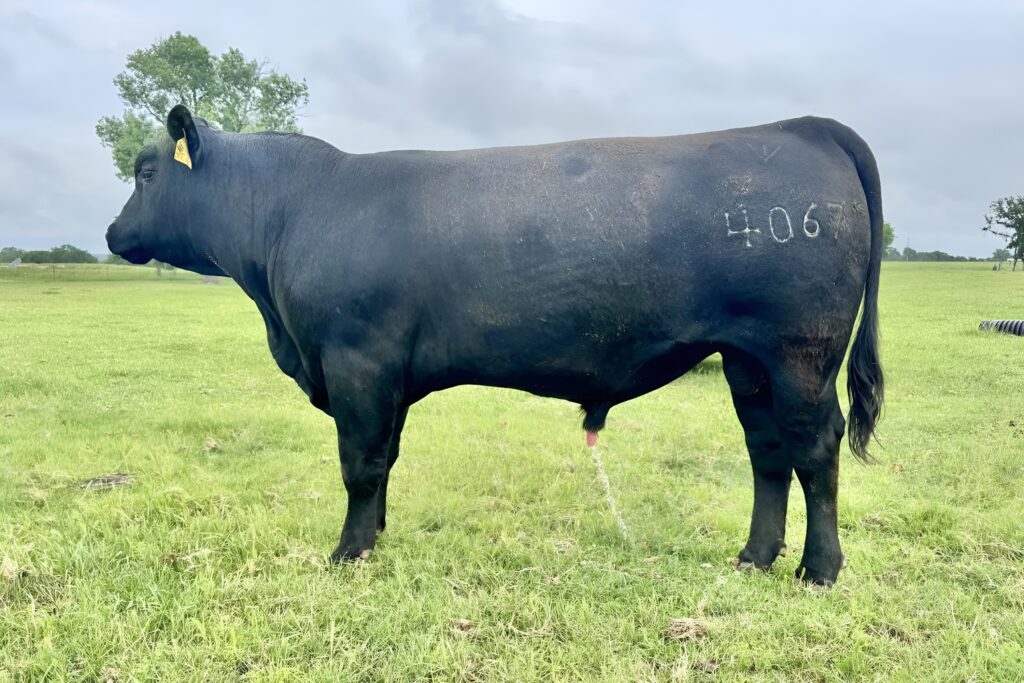
A mature Black Angus bull showing the solid black coat and moderate frame buyers look for.
Angus Cattle Facts on Color and Papers
The first thing most buyers ask about is simple: color and paperwork. A purebred black angus cow carries a solid black hide with no white markings above the flank, and that consistency is part of why the breed sells so well at weaning — buyers know what they’re getting. Registered Angus carry American Angus Association papers, commonly called AAA papers, that track pedigree, EPDs and ownership back through the dam and sire lines. Commercial black angus cattle without papers can still be excellent, productive animals; the paperwork mainly affects resale value and whether the calves can themselves be registered.
Angus Cow Weight and Frame Size
Frame size and angus cow weight are where a lot of buyers get surprised. A mature commercial Angus cow typically runs 1,100 to 1,400 pounds on a moderate frame, with registered seedstock cows sometimes heavier depending on the line. Mature bulls carry considerably more — a herd bull in working condition commonly weighs 1,800 to 2,200 pounds. Beef cattle angus size has trended toward moderate frames over the last couple of decades because moderate-framed cows breed back more reliably on grass and don’t need as much feed to hold condition through a Texas summer.
Class
Typical weight
Notes
Mature cow
1,100–1,400 lb
Moderate frame, commercial
Mature bull
1,800–2,200 lb
Working condition
Weaned calf
450–600 lb
At 6–7 months
Birth weight
65–85 lb
Low-birth-weight bulls run lower
A herd bull like this one typically carries 1,800 to 2,200 pounds in working condition.
Temperament — Why Angus Handle Easily
Angus cow characteristics that don’t show up in a sale catalog matter just as much as the ones that do, and temperament tops that list. Angus cattle are known for being calm and easy to work compared to some of the horned continental breeds, which matters if you’re running cattle by yourself on a small acreage or bringing kids into 4-H with their first heifer — our angus heifers for sale listings are a common starting point for exactly that. That said, disposition is partly genetics and partly how an animal has been handled — a gentle heifer raised on a bucket and halter-broke early will behave differently than one that’s only seen people at the chute twice a year.
Buyer note: Ask the seller how the animal has been handled, not just what breed it is. Temperament is bred for, but it’s also taught.
Calving Ease and Black Angus Calves
One of the angus cow facts that pays off every spring is calving ease. Angus bulls with low birth-weight EPDs are widely used specifically to get black angus calves on the ground without assistance, which is why you’ll see bulls marketed by their birth-weight number as much as by their frame. If you’re adding a bull specifically to tighten up calving ease in your herd, our 13 Reg. Angus Bull Calves come with birth weights and fertility guarantees listed on the page. A cow that calves easily, breeds back within 80 to 90 days and raises a calf to a solid weaning weight is doing the job a commercial operation actually needs — and if you’d rather start with a proven pair than raise a calf yourself, our angus cows for sale are already paired up.
Bred heifers like these are where calving-ease traits get tested for the first time.
Growth, Marbling and What Angus Cattle Are Bred For
Angus cattle facts about carcass quality explain most of why the breed dominates the commercial beef market. Black angus cattle marble well relative to their frame size, which is the main reason Certified Angus Beef exists as its own branded program — genetics alone don’t guarantee a Choice or Prime grade, but Angus genetics make it a realistic target more consistently than most other breeds. For a commercial cow-calf operation, that translates into calves that sell at a premium at the sale barn even without papers, simply because buyers down the chain know what an Angus-influenced calf is likely to grade.
Registered vs. Commercial — Which Facts Actually Change the Price
By the time you’re comparing two Angus cattle side by side, most of the angus cattle characteristics that separate a good animal from an average one come down to structure, disposition and performance data rather than color, since almost all commercial Angus in the U.S. are solid black. Registered bulls carry EPDs for calving ease, weaning weight, yearling weight and marbling that let you predict, on paper, how their calves are likely to perform. If you specifically want herd sires with that data attached, our angus bull sales page has current listings, and our 5 Reg. Angus Bulls come with EPDs and fertility testing on every bull. Commercial cows and pairs don’t come with that data, but a good set of eyes and a look at the calf at side tells you most of what you need.
A well-handled young heifer, the kind that grows into an easy-keeping cow.
From our place
We’ve kept Angus and Angus-influenced cattle in our program at Rochelle for a long time because they do what we need them to do without much drama — they breed back, they calve without much help most years, and the calves sell well whether they’re registered or not. What we actually select for on our own place is disposition first, then structure, then whatever the papers say, because a cow that won’t settle or won’t let you near her calf isn’t worth much no matter her pedigree. We keep a small set of registered bulls specifically to hold calving ease and growth numbers steady across our commercial cows, which is where a lot of the Angus cattle facts above actually pay for themselves.
One of the more surprising angus cow facts is that the breed originated in Aberdeenshire and Angus counties in Scotland as naturally polled, hornless cattle, which was unusual for the era. That polled trait is part of why Angus crossed so easily onto horned breeds to breed the horns out of commercial herds.
What color are Angus cattle?
Traditional Angus cattle are solid black, though the breed also comes in a red-hided variety recognized separately as Red Angus. White markings are limited to a small patch behind the navel on registered animals; anything more is usually a sign of outside breeding.
How much does a mature Angus cow weigh?
Angus cow weight for a mature commercial cow typically runs 1,100 to 1,400 pounds on a moderate frame. Registered seedstock cows can run somewhat heavier depending on the bloodline, and frame size varies enough between herds that weight alone isn’t a reliable way to judge quality.
Are Angus cattle easy to handle?
Compared to many horned or continental breeds, yes — Angus have a reputation for calm temperament that makes them a common choice for small-acreage owners and 4-H families. Individual disposition still depends heavily on how an animal has been handled from birth, not just its breed.
What’s the difference between registered and commercial Angus?
Registered Angus carry American Angus Association papers with a documented pedigree and EPDs for traits like calving ease and marbling. Commercial Angus cattle can be just as productive but don’t carry that paperwork, which mainly affects resale value and whether their calves can be registered.
Do Angus cattle need special care compared to other breeds?
Not particularly. Angus are hardy in most U.S. climates and do well on grass-based programs, though like any dark-hided breed they benefit from shade in extreme summer heat. Standard vaccination, mineral and parasite programs used for any beef herd work fine for Angus.
That’s the short list of Angus cattle facts that actually move the needle on price — everything else is worth knowing, but it won’t change what you pay or what you get.
Looking for Angus Cattle That Match These Facts?
Every animal we list is priced on the listing rather than quoted over the phone — check current angus cattle prices and know that current inventory ships to all 48 states.
Hereford · By Jonathan Jefferson · September 2026 · 8 min read
Hereford Cattle Facts: What Every First-Time Buyer Should Know
The Hereford cattle facts that matter most to a buyer aren’t the trivia — they’re the things that change how the animal performs on your place. Red body, white face, moderate frame, easy disposition, and a reputation for doing well on grass that wouldn’t carry a fussier breed. That’s the short version. The longer version is below.
We’ve bred and sold Herefords out of Rochelle, Texas for more than 25 years, and most of what follows is what we tell people standing at the fence, not something pulled off a spec sheet. If you’re ready to look at cattle instead of just reading about them, our hereford cattle for sale listings are updated as animals become available.
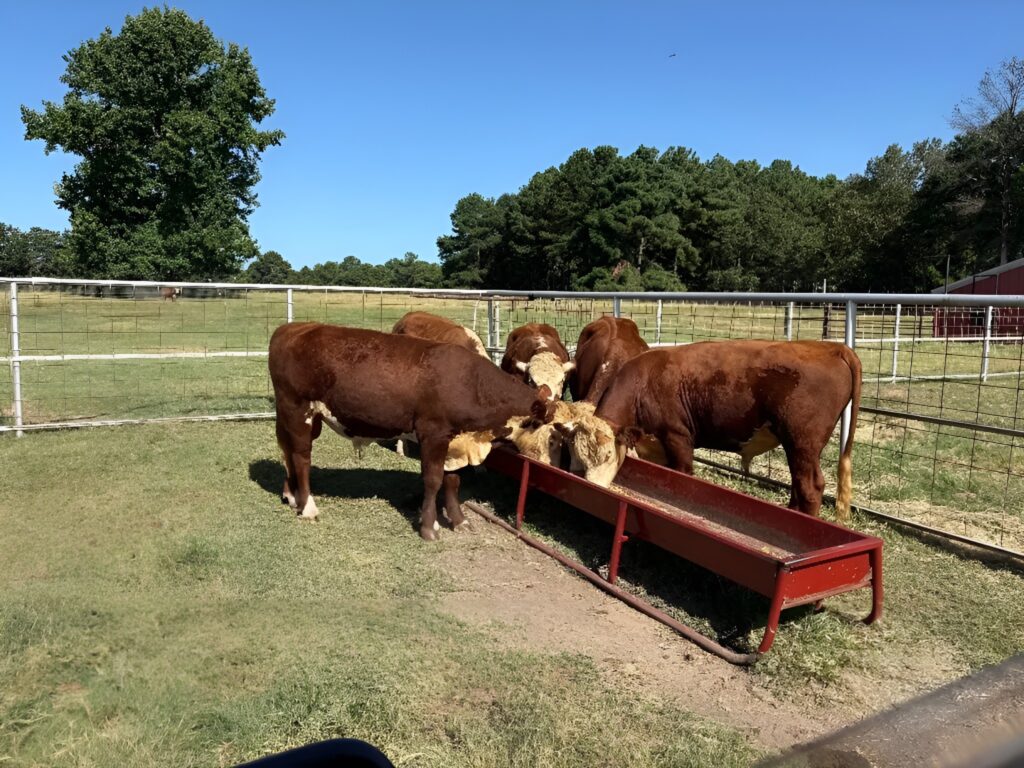
Commercial Hereford cows — the red body and white face pattern is the first thing most buyers notice.
Fact One: Hereford Cattle Facts Start With the Breed’s English Origin
The breed takes its name from Herefordshire, England, where farmers developed the cattle over generations from local stock, selecting for animals that could work hard and finish well on pasture. Hereford cattle origin traces back to that county, and the breed was brought to the United States in the 1800s, where it found a natural home on the open range of the West and, later, Texas. That history explains a lot about the hereford cattle description you’ll hear today — a moderate-framed animal built to do well without heavy feeding.
Fact Two: The Color Pattern Is Genetically Dominant
Every hereford cattle description starts the same way: a red body ranging from light red-orange to deep mahogany, with a white face, crest, dewlap, belly, and switch of the tail. What’s less commonly known is how strongly that pattern is inherited — cross a Hereford onto almost any other breed and the white face tends to show up in the calf. That’s part of why black baldy calves, out of a Hereford cow bred to a black bull, are such a common and recognizable cross in commercial herds.
Buyer note: coat color and pattern are cosmetic. They don’t tell you anything about an individual animal’s growth, fertility, or temperament — those still need to be evaluated animal by animal.
Fact Three: Horns and Polled Genetics Are Both “Real” Herefords
One of the hereford cattle facts new buyers get wrong most often is assuming horned and polled are different breeds. They’re not. Polled Herefords carry a naturally occurring hornless gene that breeders selected for and stabilized over time, and both horned hereford cattle and polled lines are registered under the same breed standard.
Why Most Commercial Buyers Choose Polled
A polled hereford cow or bull skips the dehorning step entirely, which matters at working time and cuts down on bruising in transport. We currently have 20 Reg. Hereford Bulls that include both horned and polled animals if you want to compare the two side by side before deciding which fits your operation.
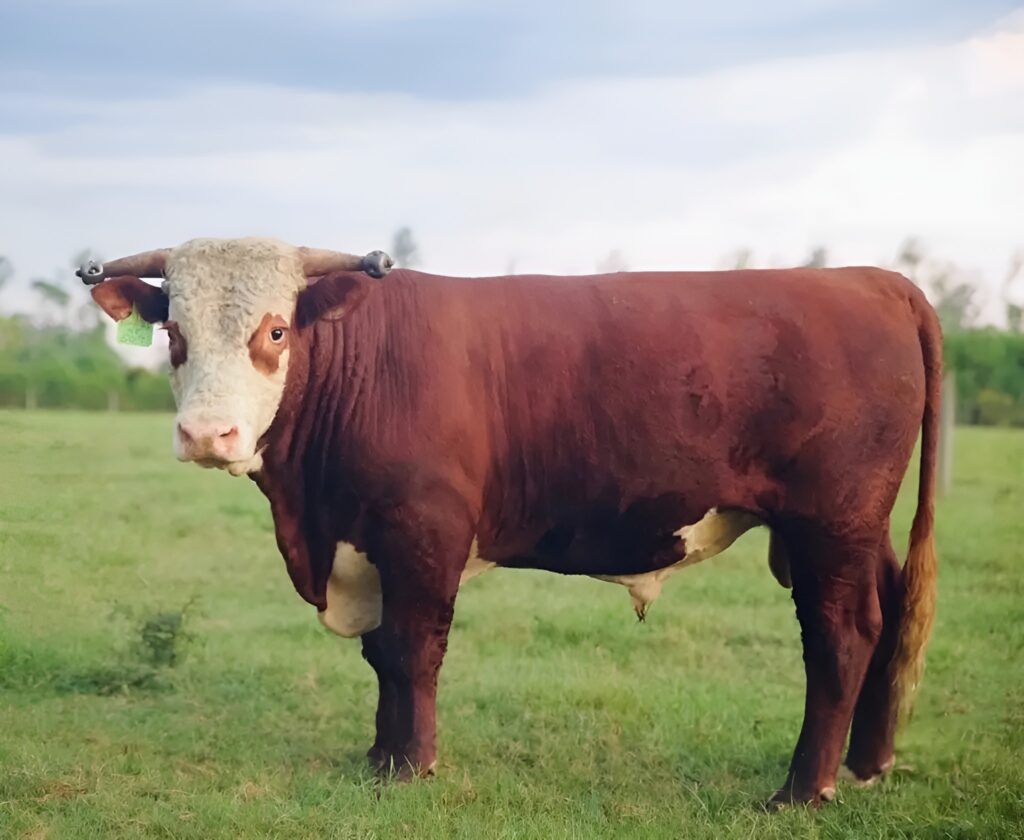
A registered horned Hereford bull — both horned and polled lines meet the same breed standard.
Fact Four: Herefords Are Built for Grass, Not Feed Bunks
Among the hereford breed characteristics that matter most to a working operation is foraging ability. Herefords hold condition on pasture that would leave a higher-input breed thin, and they don’t require the same level of supplementation to stay productive through a lean winter. That trait traces straight back to the breed’s origin on working farms where cattle had to earn their keep on what the ground produced.
This is also why Hereford genetics show up so often in crossbreeding programs across the South and West — a Hereford cow adds hardiness and easy fleshing to almost any cross. If you want more on that side of things, our post on Hereford cattle characteristics covers frame, size, and temperament in more depth.
Fact Five: Disposition Is Bred In, Not Just Luck
Facts about Hereford cows consistently mention temperament, and for good reason — Herefords are known for being calm and easy to work compared to a lot of continental breeds. That’s not an accident; generations of selection for cattle that could be handled by a working crew, not just a specialist, built it into the breed. It’s a big reason Herefords are a common first choice for 4-H and FFA families.
A Hereford cow and calf pair — maternal instinct and easy calving are two of the breed’s strongest traits.
Fact Six: Calving Ease and Maternal Strength
Hereford cows are known for straightforward calving — moderate birth weights and good pelvic structure mean fewer difficult pulls than you’ll see in heavier-muscled breeds. Once the calf is on the ground, Hereford cows are attentive mothers with enough milk to raise a strong weaning weight relative to their frame. Our 50 Hereford Cows listing is a good example of a commercial group bred for exactly that combination — moderate frame, easy fleshing, and calving ease.
Fact Seven: Hereford Beef Has Its Own Identity
Beyond the pasture, Hereford genetics carry a long-standing reputation for marbling and flavor, which is part of why there’s a dedicated Certified Hereford Beef program separate from the more familiar Angus beef brands. For registration standards, EPDs, and the full breed history, the American Hereford Association is the definitive source rather than secondhand summaries.
From Our Place
Twenty-five years in, the Hereford cattle facts that still hold up best on our operation are the practical ones: they forage well, they calve easy, and they’re not hard on a crew at working time. We run Herefords straight and crossed onto Angus, and the black baldy calves out of that cross are some of the fastest-selling pairs we list. If you’re weighing hereford vs angus for your own herd, our honest take is that the two complement each other more than they compete.
Frequently asked questions
What are some interesting Hereford cattle facts?
Beyond the red-and-white color pattern, Herefords are known for calving ease, calm temperament, strong foraging ability on marginal pasture, and a color pattern that’s genetically dominant enough to show up clearly in crossbred calves like black baldies.
Are Hereford cattle good beef cattle?
Yes — Hereford beef has a long reputation for marbling and flavor, strong enough that there’s a dedicated Certified Hereford Beef program. The breed is also valued for calving ease and foraging ability, which keeps input costs down without sacrificing carcass quality.
Do all Hereford cattle have horns?
No. Horned hereford cattle and polled Hereford cattle are both full-blooded Herefords under the same breed standard. Polled is a naturally occurring hornless trait that many breeders selected for; it doesn’t change growth, temperament, or beef quality.
Where did Hereford cattle originate?
Hereford cattle originated in Herefordshire, England, where farmers developed the breed for hardiness and grass performance. They were brought to the United States in the 1800s and adapted well to the range country of the West and Texas.
What’s the difference between a Hereford and a Black Hereford?
A Black Hereford carries the white face pattern of a traditional Hereford but with a black body instead of red, usually from crossing Hereford genetics with a black breed and then breeding back toward a stable type. They’re registered separately from traditional red Herefords.
Knowing these Hereford cattle facts before you buy means fewer surprises once the animal is on your trailer — you’ll know what frame to expect, how it should handle, and what questions to ask if something doesn’t line up.
Ready to Look at Hereford Cattle?
Every listing is priced on the listing, comes with health papers, and can be delivered to all 48 states. New buyers can start with our how to buy cattle online page.